I shared a list of scholarly references today in the hope that they would be useful for the student's IS research. I had put it off yesterday because I didn't recall citing any significant MIS literature during my own Master's work about open source innovation. Hence, I thought I wouldn't be able to assemble such a thing without a full day of further research.
(My co-supervisor had also cc:ed me on some literature by an apparently big name in the design part of MIS... I will need to be conversent on this body of work. At first glance, MIS appears well poised to discover functionalism as a style.)
To my surprise, I found that I had cited generously from /ASQ/, /MISQ/, /AMR/, /HBR/, and various organizational, design, business communications, and /research/ information management literatures without thinking about it from an MIS perspective. I had also forgotten that my external examiner was from the research information systems part of a business school, and that several of my previous research collaborators are IS people who also study research and innovation systems. Perhaps I have osmosed something about MIS after all, and I expect to learn more from this supervising adventure.
In my e-mail to the student, I tried to make it clear that he was only to consider what might be useful, and not to attempt to read or cite all of the highlighted references I sent. My co-supervisor seems more hands on with supervising the student; I hope to offer a relief valve if that becomes required.
I had also debated whether to include references my other bodies of work (urban innovation systems, e-democracy, associative governance) since they have nothing to do with the student's research area concerning e-commerce APIs and integration. In the end, I left in the urban innovation systems since the student's topic could be usefully framed as a knowledge flow topic within/among some local technology clusters.
On Monday, the student is supposed to deliver a brief paragraph about how he might approach a research question. I don't expect that he will have read Schumpeter, Foucault, Norman, Glaser, Henderson and Clark, Leydesdorff, Rogers, Latour, or von Hippel over the weekend, but I'm willing to be surprised.
Friday, August 19, 2011

Thursday, August 18, 2011
Summer recap
(Edited from an e-mail to some colleagues back home.)
The Finnish post-secondary system is more aggressive than I had anticipated. The deadline for spring PhD admissions (a complete literature review, research plan, and program timeline to be entered into a competitive review that seems to have an analogous role to the comprehensive examinations) was three weeks after my arrival in May (the department, faculty, and government paperwork did not fully resolve until July). I've extended the interdisciplinary pattern by acquiring a botanist and a computer security researcher as supervisors in addition to two from MIS.
I took seriously the local suggestion to prepare and submit a couple of manuscripts based on original research during the summer. A rebel international relations journal has accepted a paper of mine about the role of emergent internet organizations for publication in September. I've just returned from the first of several site visits in relation to long-term research infrastructures and networks (conveniently, the university's well-appointed northern research station is a key node). And I am co-supervising an MSc student as of yesterday.
I will be in the US at the end of September representing Finland a conference. That provides an opportunity to pass through the old research group for a visit, and also to sort out some NSERC bureaucracy.
The Finnish post-secondary system is more aggressive than I had anticipated. The deadline for spring PhD admissions (a complete literature review, research plan, and program timeline to be entered into a competitive review that seems to have an analogous role to the comprehensive examinations) was three weeks after my arrival in May (the department, faculty, and government paperwork did not fully resolve until July). I've extended the interdisciplinary pattern by acquiring a botanist and a computer security researcher as supervisors in addition to two from MIS.
I took seriously the local suggestion to prepare and submit a couple of manuscripts based on original research during the summer. A rebel international relations journal has accepted a paper of mine about the role of emergent internet organizations for publication in September. I've just returned from the first of several site visits in relation to long-term research infrastructures and networks (conveniently, the university's well-appointed northern research station is a key node). And I am co-supervising an MSc student as of yesterday.
I will be in the US at the end of September representing Finland a conference. That provides an opportunity to pass through the old research group for a visit, and also to sort out some NSERC bureaucracy.
Tuesday, August 16, 2011
Meeting the student
I met my MSc student at 8 a.m. in my co-supervisor's office. The student works at an IT consulting shop that does systems integration (CRM, POS, e-commerce, etc.) for (B|C)2(B|C) clients using the local region's incarnations of various parts of the stack.
I learned some more details about the MSc program from my co-supervisor. After approximately a year of study (which may start before the BSc is complete), students are allocated approximately four calendar months to dedicate to thesis writing. The institution offers no central support for writing or communications skills development. Students are expected to complete a ±50 page thesis that may arrive as chapters, or at once, for comments. My co-supervisor's approach is to do a lot of hand-holding (the kind that I would expect for a student's first undergraduate research paper). That's probably appropriate given the technical orientation of most of the students in this faculty.
I insisted on a timeline since the student expects to defend in December, and will see something that looks like a research plan on Monday. (The student is completing the last of his course requirements, and it is at this stage that supervisors are formally assigned.) I was surprised that the opponent ([external?] examiner) would only be given a week to review the completed thesis.
On evaluation of the thesis, we are to use a standard faculty grading template, which other departments within the same faculty may or may not use as their standard. I'm told that it's a very subjective template, and that some unwritten customs guide its use. Instead of the "outstanding essay" checkbox, the form has a column in which a rating of "5 - excellent" may be assigned to any component of the work. (At the low end is a check-box of "1 - sufficient".) The student expects to achieve an overall rating of 3 (for which there is no adjective), which is also the mode for MSc work. The student's main purpose for pursuing an MSc is for career advancement within his current company. He seems to get that there's more to information systems than just the technical components; a good sign. I will encourage the student to strive for a broader perspective than that, but I don't know how well the practical outcomes will stick, given the many competing demands and contingencies.
As just a PhD student, there are certain categories in which I sensibly could not assign a rating of 5 (e.g., "significance in discipline"), but I can assign a rating of 4 (supervisors who themselves hold only an MSc but are not pursuing a PhD may assign a maximum rating of 3. Only senior PhDs may give a rating of 5.
We are to help the student develop his research question based on his current work in industry in the upcoming weeks. The department places a high value empirical data in MSc work, to the point where some students mistakenly simply supply an entire thesis of data with no analysis.
Overall, the MSc here appears to combine the timeline of an honours BA or BSc with the empirical research and broader scientific impacts of an MA or MSc (or more).
After the meeting, I discussed with my co-supervisor some of the things I had learned from the meeting. I had mentioned that at Canadian universities, some academic unit had the function of an "effective writing centre" which was to ensure that students could communicate academically. My co-supervisor didn't know what to make of the concept, and couldn't identify one in any of the institutions in which she had been educated.
I learned some more details about the MSc program from my co-supervisor. After approximately a year of study (which may start before the BSc is complete), students are allocated approximately four calendar months to dedicate to thesis writing. The institution offers no central support for writing or communications skills development. Students are expected to complete a ±50 page thesis that may arrive as chapters, or at once, for comments. My co-supervisor's approach is to do a lot of hand-holding (the kind that I would expect for a student's first undergraduate research paper). That's probably appropriate given the technical orientation of most of the students in this faculty.
I insisted on a timeline since the student expects to defend in December, and will see something that looks like a research plan on Monday. (The student is completing the last of his course requirements, and it is at this stage that supervisors are formally assigned.) I was surprised that the opponent ([external?] examiner) would only be given a week to review the completed thesis.
On evaluation of the thesis, we are to use a standard faculty grading template, which other departments within the same faculty may or may not use as their standard. I'm told that it's a very subjective template, and that some unwritten customs guide its use. Instead of the "outstanding essay" checkbox, the form has a column in which a rating of "5 - excellent" may be assigned to any component of the work. (At the low end is a check-box of "1 - sufficient".) The student expects to achieve an overall rating of 3 (for which there is no adjective), which is also the mode for MSc work. The student's main purpose for pursuing an MSc is for career advancement within his current company. He seems to get that there's more to information systems than just the technical components; a good sign. I will encourage the student to strive for a broader perspective than that, but I don't know how well the practical outcomes will stick, given the many competing demands and contingencies.
As just a PhD student, there are certain categories in which I sensibly could not assign a rating of 5 (e.g., "significance in discipline"), but I can assign a rating of 4 (supervisors who themselves hold only an MSc but are not pursuing a PhD may assign a maximum rating of 3. Only senior PhDs may give a rating of 5.
We are to help the student develop his research question based on his current work in industry in the upcoming weeks. The department places a high value empirical data in MSc work, to the point where some students mistakenly simply supply an entire thesis of data with no analysis.
Overall, the MSc here appears to combine the timeline of an honours BA or BSc with the empirical research and broader scientific impacts of an MA or MSc (or more).
After the meeting, I discussed with my co-supervisor some of the things I had learned from the meeting. I had mentioned that at Canadian universities, some academic unit had the function of an "effective writing centre" which was to ensure that students could communicate academically. My co-supervisor didn't know what to make of the concept, and couldn't identify one in any of the institutions in which she had been educated.
MSc Student
It has been suggested that I supervise an MSc student.
I know the value of a good supervisor to curious and courageous students. I've also had colleagues who have had find their own way with bad supervisors. I would like to become one of the good ones.
I would also like the opportunity to examine my own views and reflect on my own knowledge from some different perspectives. A long-term commitment would help me to do that. I also hope to learn a lot from this student, both about the research topic, and whatever contexts it is situated in. I'd also like to offer something from my random assortment of experiences that may be useful to the student, the university, and the broader community.
The opportunity arose because I casually responded that I had practical experience with a research topic belonging to a student who was seeking a supervisor. I did not know that holding a Master's degree qualified me to supervise MSc students. I have never supervised a student before.
At this point, I know little about how the MSc program works in this university or department, and my supervisor who has worked here for ±20 years is not aware of any reliable documentation. (Graduate programs were consolidated into one office two weeks ago!) Difficulty modifier: The thesis will be in Finnish.
I will meet this student, and the prospective co-supervisor, tomorrow at 8 a.m. We are proceeding on the understanding that I would primarily be responsible for the non-administrative parts of the supervising (since I will be away from time to time doing research work) while my co-supervisor would handle the bureaucratic stuff and teach me about supervision as we go along.
It is my intent that this blog will help me, as well as anyone else who finds it, become better scholars in some way.
I think I will find some time this weekend to read the PhD comics archives.
To those who've had good or bad experiences on either side of the student/supervisor relationship:
Please share with me your thoughts, advice, and experiences (both good and bad) so that I may learn from them sooner rather than later. I thank you, and the student (probably) thanks you for helping to ensure that this experiment goes well.
I know the value of a good supervisor to curious and courageous students. I've also had colleagues who have had find their own way with bad supervisors. I would like to become one of the good ones.
I would also like the opportunity to examine my own views and reflect on my own knowledge from some different perspectives. A long-term commitment would help me to do that. I also hope to learn a lot from this student, both about the research topic, and whatever contexts it is situated in. I'd also like to offer something from my random assortment of experiences that may be useful to the student, the university, and the broader community.
The opportunity arose because I casually responded that I had practical experience with a research topic belonging to a student who was seeking a supervisor. I did not know that holding a Master's degree qualified me to supervise MSc students. I have never supervised a student before.
At this point, I know little about how the MSc program works in this university or department, and my supervisor who has worked here for ±20 years is not aware of any reliable documentation. (Graduate programs were consolidated into one office two weeks ago!) Difficulty modifier: The thesis will be in Finnish.
I will meet this student, and the prospective co-supervisor, tomorrow at 8 a.m. We are proceeding on the understanding that I would primarily be responsible for the non-administrative parts of the supervising (since I will be away from time to time doing research work) while my co-supervisor would handle the bureaucratic stuff and teach me about supervision as we go along.
It is my intent that this blog will help me, as well as anyone else who finds it, become better scholars in some way.
I think I will find some time this weekend to read the PhD comics archives.
To those who've had good or bad experiences on either side of the student/supervisor relationship:
Please share with me your thoughts, advice, and experiences (both good and bad) so that I may learn from them sooner rather than later. I thank you, and the student (probably) thanks you for helping to ensure that this experiment goes well.
Monday, August 15, 2011
Chaos Monkey rolls: Random mains faiure
The apartment is protected by 4 old-school ceramic fuses. One for a 20 amp circuit, and three 10 amp circuits. Visual guesses of the circuit-to-fuse relationships suggests: Fridge, microwave, electric range, dish washer, and kitchen lights on the 20 amp fuse; bathroom and/or bedroom on one 10 amp fuse; the cluster of eight outlets in the living room corner on one 10 amp fuse; and the two linked sets of two outlets on the far wall on the final 10 amp fuse.
Problem: The outlets on the far wall no longer work, and only those outlets. Nothing has been plugged into them for nearly two weeks, and I've not changed the state of any of the apparent in-wall light switches, so I have no idea what caused the state change on that circuit. All the fuses in the 1950s-era fuse box are visually identical; and the fusebox makes noises whenever power consumption increases (fridge or microwave kicks in; running Windows in a VM...). It's possible that the nearby kitchen is serviced by two circuits, with the four failed outlets hanging as an extension, but all the kitchen outlets work.
Problem: The outlets on the far wall no longer work, and only those outlets. Nothing has been plugged into them for nearly two weeks, and I've not changed the state of any of the apparent in-wall light switches, so I have no idea what caused the state change on that circuit. All the fuses in the 1950s-era fuse box are visually identical; and the fusebox makes noises whenever power consumption increases (fridge or microwave kicks in; running Windows in a VM...). It's possible that the nearby kitchen is serviced by two circuits, with the four failed outlets hanging as an extension, but all the kitchen outlets work.
Monday, August 8, 2011
I watched Finnish TV in the general lounge
It was remarkably like US Simpsons, US /Road Trip/, US /Glee/ infomercial....
Also there was a Spanish film about demons and a Great War resistance movement.
No word on the TV tax.
Also there was a Spanish film about demons and a Great War resistance movement.
No word on the TV tax.
Tuesday, August 2, 2011
"Area of reindeer husbandry" - roadsign
(I'm at a field station this week. The following are photos from the trip.)
The reindeer are semi-domesticated. Tags behind the ears let the game wardens know which ranch each animal belongs to during culling season. Somehow, reindeer vs auto accidents are sufficiently regular and non-fatal that there is boring paperwork and compensation to the owner (in the form of a fine to the driver) for hitting one.

Road-side rural bus stop. Schedules accurate to the minute. At least 12 buses a day.

Main street inLeduc Oyen every little small town on the Greyhound Matkahuolto milk run.

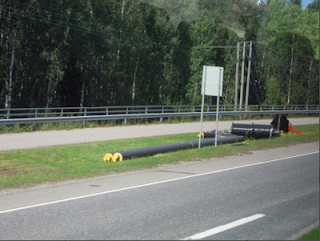
Geothermal being installed to many of the two dozen hamlets en route. They were finishing up fibre pulls as well.
Revolving restaurant, space ship golf tee, and water tower.

Driving past Canmore^W Käylä.

Oulanka field station (not an ex-WWII prison camp, like KFS...)

The reindeer are semi-domesticated. Tags behind the ears let the game wardens know which ranch each animal belongs to during culling season. Somehow, reindeer vs auto accidents are sufficiently regular and non-fatal that there is boring paperwork and compensation to the owner (in the form of a fine to the driver) for hitting one.

Road-side rural bus stop. Schedules accurate to the minute. At least 12 buses a day.

Main street in

Geothermal being installed to many of the two dozen hamlets en route. They were finishing up fibre pulls as well.

Revolving restaurant, space ship golf tee, and water tower.

Driving past Canmore^W Käylä.

Oulanka field station (not an ex-WWII prison camp, like KFS...)

Subscribe to:
Posts (Atom)